Plan an Axis Deer Hunt Around the Species and the Property
An axis deer hunt can look familiar to a whitetail hunter until the details begin to diverge. The spotted coat remains into adulthood, groups may contain several watchful animals, and the calendar does not necessarily follow the local whitetail season or rut. The hunt also changes substantially between a private Texas property and a regulated island opportunity in Hawaiʻi. Before choosing equipment or travel dates, establish which animals are available, how the property is managed, what access you are purchasing or applying for, and what the responsible wildlife authority requires. Those answers turn an attractive photograph into a realistic plan and help you judge the experience on more than antler size.
Recognize an Axis Deer Before You Evaluate It
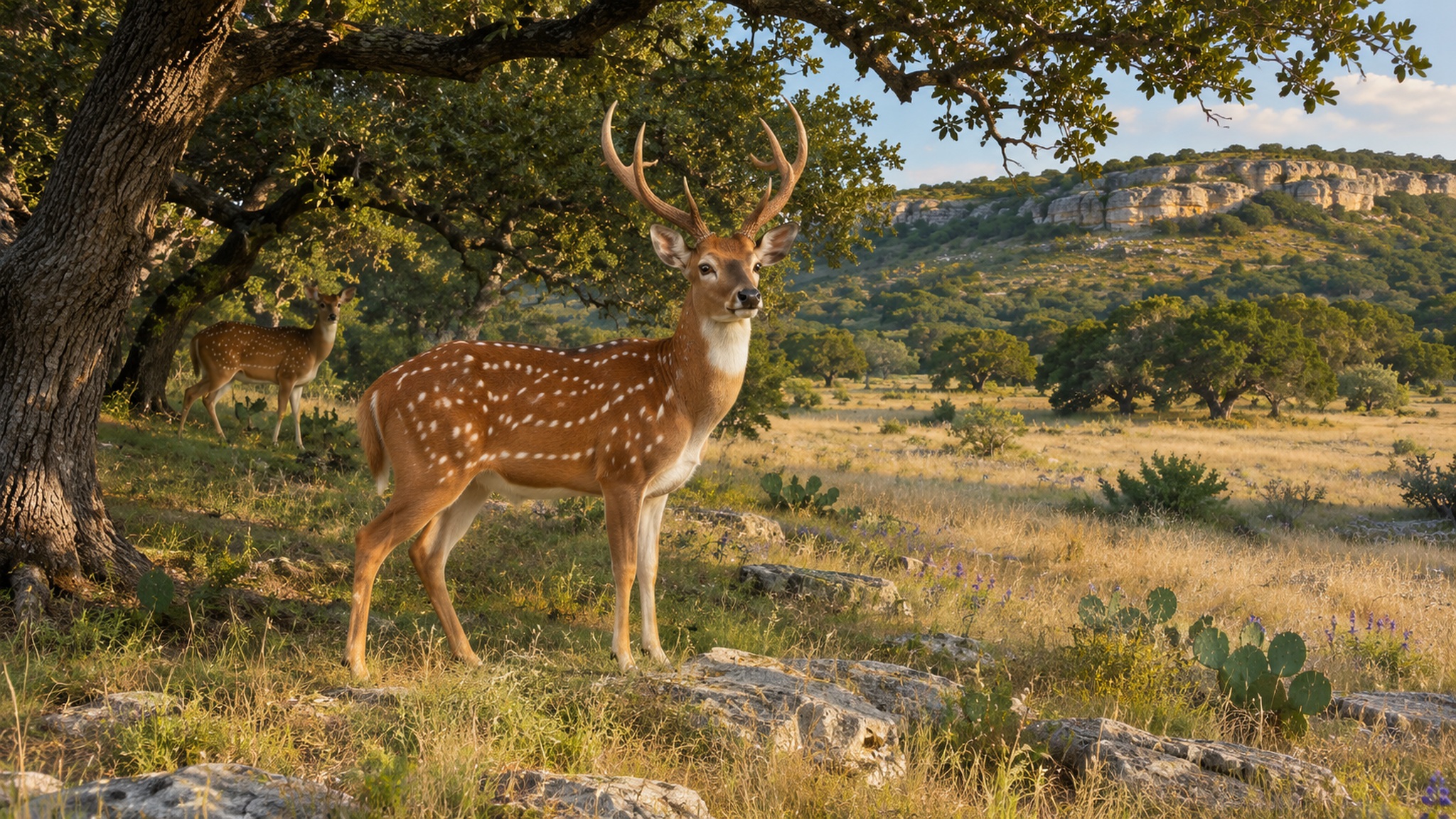
Axis deer, also called chital, originate from South Asia and have been introduced elsewhere. Adults commonly show white spots across a reddish coat, a pale throat, and a darker line along the back. Mature males carry antlers with a characteristic three-point arrangement on each side, although damage and individual variation can complicate a distant view. Learn the complete appearance rather than relying on spots alone, since other deer species can also be spotted. Look carefully at antler form, body proportions, and the animals accompanying the individual. Identification comes before deciding whether a particular deer matches the conditions of your hunt.
Understand What the Calendar Actually Means
Axis antler and breeding cycles need not align neatly with a North American whitetail calendar. Animals on the same landscape can be in different reproductive or antler stages. That makes a broad promise about the perfect month less useful than recent information from the property. Ask what has actually been observed and how the operator distinguishes a preferred period from a guaranteed outcome.
If your interest is a hard-antlered male, say so explicitly before booking and ask what happens if the available animals do not meet that description. A hunt advertised for axis deer may cover females, young animals, or a management objective different from yours. Clarifying the intended animal is part of understanding the product rather than a reason to demand certainty from wildlife. Obtain the arrangement in writing.
Weather still influences the experience even where a legal season is broad. Heat changes hunter comfort and meat-care demands, while rain affects access and footing. Plan around the conditions you can reasonably manage rather than choosing a date solely because photographs suggest large antlers. A well-timed trip balances the species, property, physical demands, and realistic recovery arrangements.
Separate Texas Rules From Island Rules
Texas classifies axis deer as exotic animals. Its official exotic-species guidance describes broad private-property hunting provisions while retaining hunting-license and landowner-permission requirements. Do not carry those provisions onto a public hunt or into another state. The permission, property conditions, and rules for your exact hunt remain essential.
In Hawaiʻi, island, unit, season, and permit conditions can determine the opportunity. The Lānaʻi hunting information page directs hunters to current announcements, applications, and local branch guidance. Consult those sources for the hunt year and verify any lottery, tag, check-in, access, and equipment requirements. A story about a friend’s previous season is useful background, but it cannot establish your authorization to hunt.
Ask What Kind of Access the Property Provides
Private exotic hunts differ in acreage, fencing, animal origin, stocking practices, guide involvement, and how a day in the field unfolds. Ask directly about those conditions before paying a deposit. Find out whether animals are free-ranging across a broad landscape or confined within an enclosure, how heavily the area is hunted, and what hunting methods are offered. These details shape both the challenge and your personal view of fair chase. An honest operator should be able to explain them clearly. If the answer changes from the advertisement to the conversation, resolve the discrepancy before travel. The best arrangement is one you would still choose after hearing exactly how the property functions.
Watch Groups Before Planning an Approach
A group of deer presents several sets of eyes and ears. While one animal feeds, another may be looking toward the area you intend to cross. Observe the whole group and the terrain around it rather than becoming fixed on one male. Determine which animals are alert, which direction the group is moving, and whether a route exists that respects both wind and cover.
A group that disappears behind brush may continue moving even if the last deer seemed relaxed. Avoid rushing to the place where you last saw antlers. Rebuild the picture from a position with useful visibility, and allow the possibility that the animals have crossed a boundary or moved beyond lawful access. An incomplete view is a reason for patience, not a reason to assume the desired animal remains alone and exposed.
Use Terrain Without Losing the Larger Picture
Rolling ground, oak cover, grass openings, and rocky slopes can create alternating views and concealment. Before moving, identify where you can stop and observe again. A route that hides your outline may also hide the deer, livestock, or another party from you. Balance concealment against the need to keep the situation understandable. A guide’s local knowledge can help, but the hunter still needs to recognize the conditions under which continuing no longer makes sense.
Pay attention to footing and vegetation. Loose limestone, thorny brush, and steep side slopes can turn a short distance into a physically demanding approach. Wear footwear you have already used on similar ground and carry water appropriate to the weather. If the route requires more climbing, crawling, or balance than you can manage comfortably, say so before the group commits to it.
Approach planning should include the return and any potential recovery. An accessible hillside from one direction may be difficult to reach from below, particularly as temperatures rise. Ask how the property handles retrieval and who provides the necessary transport. Thinking through that work before an encounter makes the entire hunt more responsible.
Choose Familiar Equipment That Fits the Conditions
There is no special equipment purchase that substitutes for demonstrated competence with a legal hunting setup. Confirm the property’s requirements and the jurisdiction’s rules, then use equipment you can manage safely under the expected conditions. Practice with the clothing, support, and distances relevant to the hunt rather than assuming range familiarity transfers automatically to steep or uneven ground. Optics that let you observe antlers and surrounding animals clearly may be more useful than an additional accessory. Keep equipment manageable enough that heat, terrain, and fatigue do not overwhelm the attention you need for identification and judgment.
Clarify the Price Before You Compare Hunts
A quoted hunt price can represent very different things. Ask whether the charge covers guiding, lodging, meals, transport on the property, a particular animal class, field care, and processing delivery. Determine how fees change with animal size or hunt outcome and what the agreement says about a wounded animal. Those conditions matter more than a low opening number in an advertisement.
Also ask about cancellation, weather disruption, rescheduling, accompanying guests, and gratuities. Keep the total travel cost separate from the hunt fee so you can compare complete trips. A short private-land hunt close to home and an island hunt requiring flights may both be worthwhile, but they solve different travel and budget needs. Current written terms are a stronger basis for comparison than an old online price.
Make Heat and Meat Care Part of the Booking
Warm-weather hunting creates a short margin for careless handling. Confirm how quickly an animal can be retrieved, where clean field care occurs, and what cooling facilities are available. Do not assume that a lodge has adequate refrigeration for every successful hunter or that a processor is open when you plan to arrive. Discuss the sequence with the operator before the hunt rather than asking after a harvest.
For a traveling hunter, the plan continues beyond the property gate. Ask how meat will be packaged, held, and transported, and check current airline and destination requirements where relevant. If you cannot take the meat home, establish a lawful, agreed arrangement before booking. A vague intention to find someone who wants it later leaves an avoidable responsibility unresolved.
Handling supplies should support cleanliness and the actual conditions. Keep protective gloves and clean containers accessible, and follow current local wildlife-health guidance. If a guide or processor performs the work, ask what you are expected to provide and what happens during delays. The quality of the recovery and cooling plan is part of the quality of the hunt.
Evaluate Claims About Conservation Carefully
Introduced deer can affect vegetation and native ecosystems, but that does not mean every paid hunt automatically produces a meaningful conservation benefit. Ask what the management objective is, how harvest relates to it, and whether the operation monitors results. A commercial trophy objective, a population-reduction effort, and a public recreational hunt can involve different priorities. Treat those distinctions honestly.
Respect also extends to local communities, neighboring landowners, and the people managing access. Follow instructions about roads and gates, avoid spreading soil or plant material between sites, and leave the property clean. If an operator describes ecological benefits, look for a specific mechanism and evidence rather than accepting a general slogan. Responsible participation begins with understanding the arrangement you support.
Arrive With a Plan You Can Explain
Before departure, you should be able to describe the authorized animal, access conditions, current rules, expected terrain, costs, and recovery process without guessing. Share the itinerary and emergency contact arrangements with someone who is staying home. Confirm where communications work and who makes weather or access decisions during the hunt. These practical details deserve the same attention as the anticipated animal.
Use the final conversation with the operator to resolve the remaining uncertainties. Recent observations may change your expectations about antler condition or where deer are using the property. A realistic adjustment before arrival is better than frustration created by an assumption nobody discussed. Bring patience for wildlife and a clear understanding of your own limits.
Axis deer hunting becomes more rewarding when the species, landscape, and management conditions are treated as parts of one experience. Learn enough about each to ask informed questions and recognize when an opportunity does not fit the plan. A memorable hunt does not require every advertisement to come true. It requires lawful access, sound judgment, responsible follow-through, and an honest account of what happened.
Keep the Hunt Record Useful After You Return
Save the agreement, authorization details, and the practical lessons from the trip in one place. Record what the terrain required, how long retrieval took, which services were useful, and which expectations needed adjustment. If you return to the same property, that record gives you concrete things to discuss instead of relying on a pleasant overall memory. If you choose another destination, it helps you compare the conditions that mattered most. Describe wildlife observations accurately, including the antler stages and group behavior you actually saw, without turning one trip into a universal account of the species. A thoughtful record also makes recommendations to friends more useful: explain who the trip would suit, what preparation it required, and where uncertainty remained. That is a better contribution than repeating a trophy photograph with none of the circumstances that made the experience possible.