Identify Deer Sign by Comparing Clues, Not Choosing a Favorite One
A split print, a cluster of pellets, and bark missing from a sapling can all suggest deer activity. None should be interpreted without considering its shape, condition, setting, and possible alternatives. Livestock also leave cloven hoof impressions, several mammals produce pellet-like droppings, and trees lose bark for reasons unrelated to antlers. The most reliable identification combines several compatible clues while preserving the difference between what is visible and what remains uncertain. Start with the clearest evidence, compare it with a dependable regional reference, and use the surrounding habitat to test rather than dictate the conclusion. This approach helps hunters and wildlife watchers recognize deer use without claiming an animal’s sex, age, or future arrival from one mark.
Begin With the Local Species List
The alternatives present in your region determine which comparisons matter. A whitetail identification exercise in an eastern woodland differs from one beside western mule deer habitat or a pasture containing goats. Learn which native deer, other hoofed wildlife, and domestic animals occur near the site. A track cannot be evaluated sensibly if the likely alternatives are missing from the comparison.
Use a regional agency guide or a reliable field reference that includes scale and several examples. The Missouri Department of Conservation’s white-tailed deer account provides a useful species reference. A drawing helps establish basic structure, but real impressions vary with the surface. Compare the complete pattern rather than expecting every print to match a clean illustration exactly.
Understand the Divided Hoof
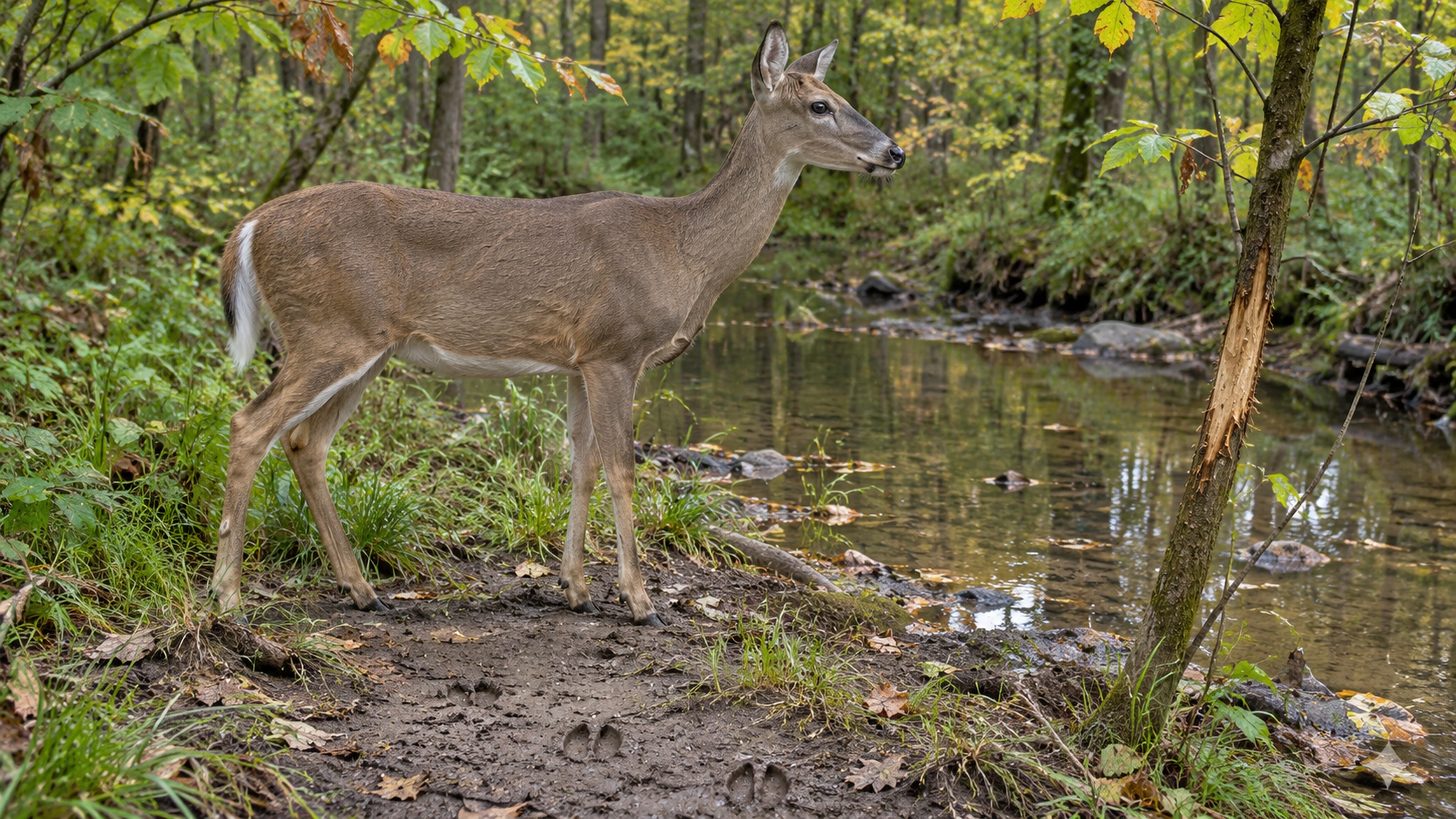
A deer hoof normally leaves two main impressions, often with a tapered appearance toward the front. The gap, outline, and degree of spreading change with movement and footing. A print in firm damp soil can look quite different from the impression left by the same animal in deep mud.
Additional small marks behind the main hoof can be dewclaw impressions, but their presence is not a shortcut to identifying a buck. Soft ground and movement can influence whether those marks register. Examine several prints and the conditions that produced them before using a detail to narrow the identification.
Do not convert apparent size into an unsupported claim about the animal. Melting, sliding, overlapping tracks, and soft ground can exaggerate dimensions. A measured print is useful evidence when the substrate is recorded with it. It does not reveal antler size, and it may not distinguish species whose track dimensions overlap.
Look at a Series Before Naming the Maker
Several consecutive impressions provide information that a lone mark lacks. You can inspect how the feet relate, whether another track overlaps, and whether the apparent direction remains consistent. A partial hoof print can resemble an unrelated shape when viewed alone. A series gives that shape a context. Photograph more than the most attractive impression, and include enough surrounding ground to show the relationship. If the series is mixed with other animals’ tracks, keep that limitation visible rather than selecting only the marks that fit your preferred answer.
Compare Deer With Livestock and Other Hoofed Animals
A deer print has two principal hoof impressions; a typical dog print has a pad and four toe impressions, sometimes with visible claws. A partial dog print can lose that recognizable structure, so compare complete neighboring prints. Goats, sheep, and other hoofed animals can produce impressions that confuse a quick identification. Nearby fencing or pasture access increases the importance of considering domestic animals. Wildlife alternatives depend on the region and can include other deer species or larger hoofed mammals. Habitat provides a useful starting point, but an animal can travel outside the place you expect it to occupy.
Compare dimensions, outline, and the larger sequence using a suitable reference. Avoid one-rule identification claims such as assuming every pointed print belongs to a deer or every spread hoof belongs to one sex. When the evidence remains insufficient, the accurate conclusion may be that a hoofed animal passed. That narrower statement is more useful than a confident species label the ground cannot support.
Read Droppings Without Handling Them
Deer commonly leave groups of dark oval pellets; rabbit pellets are generally rounder. Compare intact examples, since moisture, diet, weathering, and other conditions affect appearance. Shape is a useful comparison, not a species verdict by itself. Some droppings can appear clumped rather than neatly separated. Other mammals produce pellets as well, so shape and grouping need to be compared with regional references and nearby sign. The Maryland Department of Natural Resources animal-sign guide illustrates deer pellets and hoof structure. Inspect and photograph droppings without touching them, avoid contaminating equipment, and wash appropriately after field activity. Scat is an observation to document, not a specimen that must be handled to make the outing worthwhile.
Keep Freshness Claims Modest
Appearance can help compare droppings or tracks in the same setting, but exact age is difficult to establish from looks alone. Sun, rain, freezing, moisture, shelter, and the surface can change how quickly evidence loses detail. A glossy pellet under shade and a dry pellet in an exposed opening cannot necessarily be placed on one simple timeline.
Known events offer better context. Evidence lying on fresh snow was made after that surface formed, subject to drifting and other complications. A rain-softened track can be compared with the surrounding soil and recent conditions. These observations can narrow an interpretation without justifying an exact hour or a precise prediction about when the animal will return.
Distinguish fresh evidence from evidence that merely looks clear. A sheltered impression can remain sharp after nearby exposed tracks deteriorate. Write down the conditions behind your estimate so the conclusion can be reconsidered later. The strength of the explanation depends on those conditions, not on how confidently the estimate is stated.
Recognize Rubs as Tree Damage With Context
Deer can remove bark while rubbing antlers, often leaving abrasion and associated disturbance on small trees or shrubs. Look at the texture, location, and surrounding signs rather than identifying every damaged sapling as a rub. Equipment, falling limbs, other animals, and ordinary injuries can also strip or scar bark.
A likely rub supports deer activity without reliably identifying the individual responsible. Tree size does not provide a dependable measure of antler size. Likewise, a line of damaged saplings should be assessed for age and cause before becoming a precise travel route on a scouting map. Several compatible observations can strengthen the explanation while still leaving individual identity unknown.
Interpret Scrapes as Disturbed Ground, Not Appointments
A scrape associated with deer activity often includes disturbed soil beneath an overhanging branch. Examine the combination rather than naming any patch of bare ground a scrape. Nearby tracks can help, but common use and overlapping evidence can complicate interpretation. A scrape can be visited by multiple deer, and finding one does not establish when the next visit will occur. Separate identification of the feature from predictions about an animal’s daily schedule. That distinction keeps an interesting discovery from becoming an expectation the evidence never promised.
Compare Browsing With Other Plant Damage
Inspect the broken end of a stem rather than treating every missing shoot as deer feeding. Deer lack upper front incisors and commonly leave torn, ragged ends. Rabbits can clip small stems cleanly at an angle.
Penn State Extension describes this useful contrast in its deer and cottontail guidance. Weathering can obscure the original edge, and a broken twig alone remains weak evidence.
| Observation | Useful comparison | Limit |
|---|---|---|
| Two main hoof impressions | Deer or another cloven-hoofed animal | Not a deer-only feature |
| Pad with four toes | Consider a dog track | Incomplete prints hide structure |
| Ragged browsed stem | Consistent with deer feeding | Sheep can leave similar damage |
| Clean angled clipping | Consider rabbit feeding | Inspect several fresh examples |
The comparison narrows possibilities without supplying certainty. Forest Research notes that sheep and deer browsing can be difficult to separate; nearby wool, tracks, and livestock access may matter more than the twig itself. Photograph both the damaged end and the surrounding plant. Use the combination to decide whether deer are the strongest explanation.
Build a Record That Can Be Checked
Photograph a clear example, a wider view, and a scale placed beside rather than inside the evidence when appropriate. Record the location, surface, weather, and uncertainty. A photograph without scale can make a small mark seem large, while a close crop can hide the alternative explanation that was visible nearby. Good documentation preserves context as well as detail.
Write the observation first and the interpretation second. For example, describe paired hoof impressions and nearby pellets before labeling the site likely deer use. If you later learn that livestock had access, the original description remains useful even though the interpretation changes. This habit makes field learning cumulative instead of requiring every early conclusion to be defended.
Choose the Confidence the Evidence Deserves
Identification works best as a comparison among explanations. Begin with local species, inspect structure and scale, assess substrate, and ask whether other evidence fits. If a better alternative remains plausible, leave the identification provisional. A careful observer can say probable deer sign without claiming certainty, and can say confirmed deer activity without claiming a particular buck.
Take the same restraint into practical decisions. Sign can guide further observation, habitat assessment, or low-impact scouting, but it cannot replace positive identification of a live animal or the current rules governing access and hunting. An exciting discovery does not remove those requirements. Keep the purpose of the sign clear and do not ask it to establish facts it cannot contain.
The most useful result is often a specific, limited conclusion: deer have used this crossing, this plant shows probable browsing, or this damaged sapling needs another look. Those conclusions can be tested with later observations. Over time, comparing clear examples with uncertain ones builds a more dependable eye than memorizing a handful of absolute rules.
Work Through a Confusing Sign Cluster
Suppose a muddy gate contains divided-hoof prints, a few dark pellets, and a nearby damaged sapling. Begin by documenting each clue separately. The gate may be used by both deer and livestock, the pellets may have arrived at another time, and the tree damage may be older still. Proximity does not prove that one animal produced the entire cluster. Look for compatible dimensions and structure while checking access to the pasture and the age of the bark damage. The strongest conclusion may be mixed hoofed-animal use rather than a confirmed deer route. That conclusion preserves more truth than selecting the deer explanation because the three clues appear close together.
At a second location, you might find several clear hoof impressions continuing into woodland, consistent pellet groups, and probable browsing nearby. The explanation of deer use becomes stronger because multiple observations fit without requiring every clue to come from one individual. Record which evidence carries the identification and which merely supports it. If a camera later records deer there, it adds a separate observation; it does not retroactively prove the age or maker of every original mark. This distinction helps a beginner learn from confirmation without exaggerating what was known at the start. When discussing the finding with someone else, show the original photographs and context rather than only the final label. That allows an informed observer to check the identification, suggest alternatives, and explain why one feature may be more useful than another. When sharing an identification online, include the region and the uncropped context that helped you compare alternatives. Invite correction of the evidence rather than asking others to endorse a chosen label. A useful discussion should make the reasoning clearer and leave the original observation intact for anyone who wants to examine it.