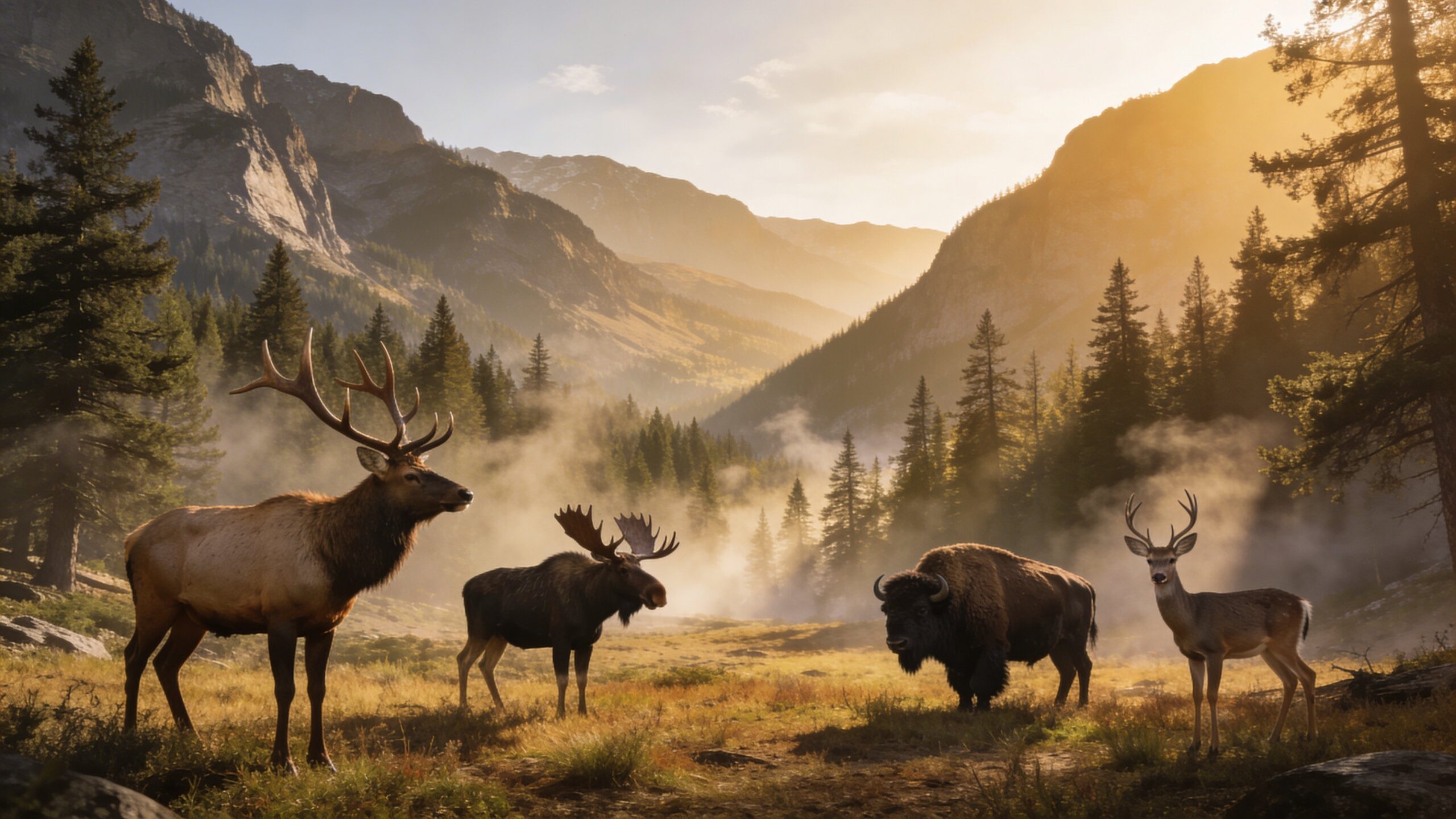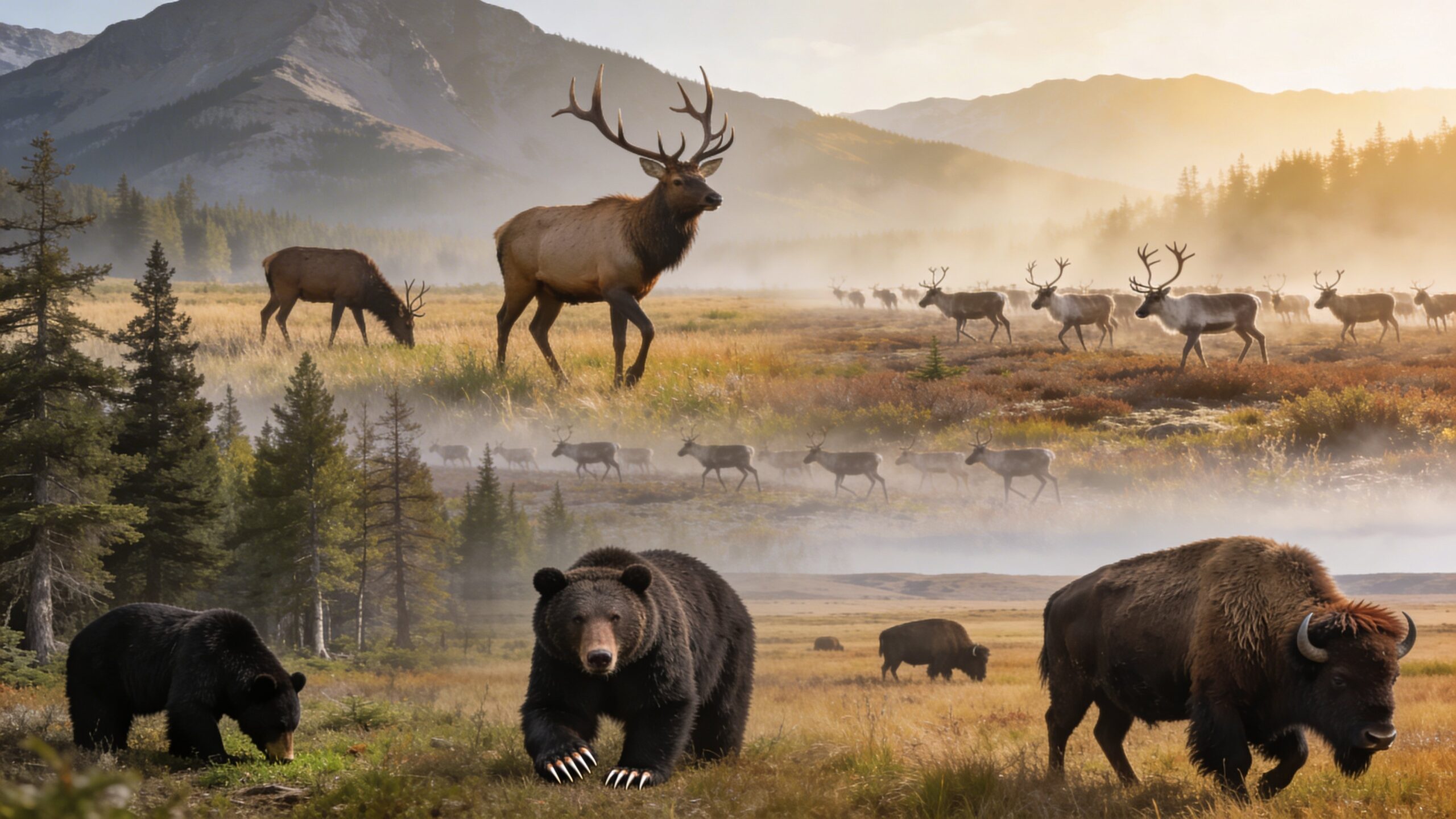
Big game is one of those terms that sounds simple until you start looking closely at what it actually means. In casual conversation, people often use it to describe any large wild animal. In wildlife management, outdoor culture, and conservation, however, the phrase usually refers to a more specific group of large mammals that stand out because of their size, ecological role, and public interest. Across North America, the label commonly includes animals such as deer, elk, moose, pronghorn, bison, mountain sheep, mountain goats, black bears, and in some jurisdictions mountain lions. State and federal agencies do not always use exactly the same list, which is why the term can feel broader in one place and narrower in another. Understanding what is considered big game in North America matters for more than vocabulary. These animals shape habitats, influence food webs, attract wildlife watchers, and occupy an important place in conservation history. They are often among the most visible and charismatic mammals on the continent, yet each species survives by following highly specialized patterns of movement, feeding, breeding, and seasonal adaptation. Once you understand what falls into the big game category, the entire landscape starts to look different. Forest edges, mountain basins, open plains, river bottoms, and tundra corridors are no longer just scenery. They become the living stage for some of the continent’s most powerful wildlife stories.
A: No. Size matters, but habitat needs, ecological role, and management status matter too.
A: Yes. Deer are among the most common big game animals in North America.
A: Often yes, especially black bears in many state systems.
A: In some jurisdictions, yes.
A: Yes. They are one of North America’s most iconic big game species.
A: Agencies and locations use slightly different legal and management categories.
A: No, but many make important seasonal movements.
A: They shape habitats, influence food webs, and reflect ecosystem health.
A: No. Pronghorn are unique to North America.
A: Think of North America’s largest, most influential land mammals and the landscapes they define.
What the Term “Big Game” Usually Means
In North America, big game usually refers to larger terrestrial mammals that are prominent in wildlife classification and management systems. In practice, that often means hoofed mammals such as deer, elk, moose, pronghorn, bison, bighorn sheep, and mountain goats, along with certain large carnivores such as black bears and mountain lions depending on the jurisdiction. Yellowstone’s large-mammal complex alone includes eight ungulate species such as bison, elk, moose, mule deer, pronghorn, and bighorn sheep, alongside major predators including black bears, grizzly bears, and mountain lions, which helps illustrate the scale and ecological visibility associated with the category.
The key idea is that big game is not merely about body size. It is also about ecological significance and management attention. These animals tend to require larger home ranges, broader habitat connectivity, and more deliberate stewardship than many smaller species. They are also the mammals most people picture when they imagine North American wilderness: a bull elk crossing a meadow, a moose standing in a willow marsh, a bison herd moving across grassland, or a bear foraging along a forest edge.
Why the Definition Can Vary
One reason people get confused about big game is that there is no single continent-wide legal list that applies everywhere. Different wildlife agencies define and regulate game animals in slightly different ways. Some places emphasize common ungulates such as deer, elk, moose, and pronghorn. Others add mountain lions, black bears, mountain goats, wild bison, or sheep. On some federal refuge lands, big game access may be limited to a smaller set of species, while a state hunting definition may include a wider group. For example, one refuge in Wyoming lists elk, white-tailed deer, mule deer, moose, and pronghorn as big game, while Montana’s current regulations define game animals more broadly to include deer, elk, moose, antelope, caribou, mountain sheep, mountain goat, mountain lion, black bear, and wild bison. That variation does not make the term meaningless. It simply means that big game is both a biological and administrative category. Broadly speaking, if a species is a large, free-ranging mammal with major ecological presence and a long history of management attention, it is likely to be treated as big game somewhere in North America. The finer details depend on place, policy, and tradition.
The Core Big Game Species of North America
When most people talk about North American big game, they are usually thinking first of the continent’s large hoofed mammals. Deer are central to that picture. White-tailed deer and mule deer are among the most familiar and widespread examples, occupying forests, shrublands, foothills, agricultural edges, and broken country across huge portions of the continent. Elk add a larger, more dramatic version of the deer template, with strong herd behavior, seasonal movement, and powerful rut displays. Moose stand at the giant end of the deer family, closely associated with wetlands, willow thickets, lake margins, and northern forests. Pronghorn bring speed and open-country specialization, while bighorn sheep and mountain goats represent the high-country specialists of cliffs, ridgelines, and exposed alpine terrain. Bison anchor the grassland side of the big game story, embodying both physical mass and ecological impact. Yellowstone and other western landscapes provide especially vivid examples of how these species coexist as part of a large-mammal system.
These species dominate the public imagination because they are both visually striking and ecologically influential. They feed at a scale that affects vegetation, they move across large distances, and they support predator populations. They also vary enormously in temperament and habitat use. A pronghorn built for speed on the plains lives a very different life from a moose browsing in a boreal wetland or a sheep navigating a canyon wall, yet all belong comfortably within the big game idea.
Bears, Mountain Lions, and the Predator Question
Predators complicate the definition of big game, but they are often included. Black bears are classified as big game in several jurisdictions, and mountain lions are also recognized that way in some state systems. Yellowstone’s large-predator network includes black bears, grizzly bears, and mountain lions, underscoring the fact that large carnivores are inseparable from many of the same landscapes that support iconic ungulates. Including predators makes sense when you look at how ecosystems work. Big game is partly about size and partly about influence. Large carnivores shape prey behavior, redistribute risk across landscapes, and help keep herbivore populations in ecological balance. Even when a specific area or rulebook draws a tighter line around which predators count, the broader cultural understanding of big game in North America nearly always includes them in the conversation. It is hard to talk seriously about elk, deer, or bighorn sheep without also talking about the animals that pursue them.
The Ecological Role of Big Game
Big game animals do far more than occupy space. They help create the living structure of ecosystems. Grazers such as bison and elk can alter plant communities through repeated feeding pressure. Browsers such as deer and moose affect young tree growth, shrubs, and wetland vegetation. Their movement patterns distribute nutrients, open trails, and connect habitats across seasons. Large predators, in turn, influence where prey feed, rest, and travel. Yellowstone’s wildlife materials note that elk abundance can influence plant diversity, soil fertility, and other animal communities, showing just how wide the ecological ripple can become when a major big game species changes in number or behavior.
This is one reason the big game category carries such weight in conservation. These are not background animals. They are landscape-scale actors. When their numbers fall or rise sharply, entire habitat patterns can shift with them. Protecting big game is therefore often inseparable from protecting migration corridors, winter range, water access, predator-prey relationships, and long-term ecosystem resilience.
Habitat: Where Big Game Lives
Big game in North America is spread across an extraordinary range of environments. Forests support white-tailed deer, black bears, moose, and elk. Mountain systems support sheep, goats, elk, bears, and mountain lions. Plains and prairie regions are strongly associated with bison and pronghorn. Northern tundra and subarctic landscapes define the great caribou story. Wetland edges and willow-lined creeks are classic moose territory. Rocky canyons and broken escarpments create natural homes for bighorn sheep. The variety is part of what makes the category so compelling. Yet despite that diversity, most big game species share a few landscape needs. They need room. They need seasonal food security. They need safe movement between critical habitats. In many cases, they need entire annual cycles of connected terrain rather than one isolated patch. A mountain basin may function as summer range, a lower valley as winter refuge, and a river corridor as a travel route between them. That broad spatial footprint is one of the clearest marks of true big game.
Movement, Migration, and Seasonal Change
Some of North America’s most remarkable wildlife events are tied directly to big game movement. Caribou are famous for long-distance migration, but they are not alone. Elk, mule deer, and pronghorn also make important seasonal movements in many regions. These journeys track snow depth, forage quality, breeding needs, and weather pressure. They are not random wanderings. They are highly organized survival strategies refined over generations.
Seasonality affects nearly every aspect of big game life. Autumn rut behavior transforms deer and elk from cautious grazers into restless, visible competitors. Winter compresses activity and raises the value of shelter, fat reserves, and reliable forage. Spring shifts attention toward green-up, calving, and nutritional recovery. Summer allows growth, antler development, and wider access to productive range. To understand what is considered big game, it helps to recognize that these species do not just live in habitats. They move through time as much as they move through space.
Big Game and Conservation History
Big game occupies a central place in the North American conservation story. Many of these animals experienced severe declines in earlier eras due to overharvest, habitat pressure, and weak regulation. Their recovery helped shape modern wildlife management. The Boone and Crockett Club notes that its records program became closely tied to tracking the recovery and management of North American big game populations, reflecting the long-standing link between these species and conservation metrics. Today, big game conservation is about much more than population counts. It is about habitat continuity, science-based management, disease monitoring, coexistence with expanding human development, and adaptation to climate stress. Agencies increasingly have to think at landscape scale, because the lives of these animals do not fit neatly inside one park, one state, or one season. The category matters precisely because these species require long-term, coordinated thinking.
Common Animals People Ask About
People often wonder whether certain species count as big game or not. Deer, elk, moose, pronghorn, sheep, goats, and bison almost always fit the category somewhere in North America. Black bears frequently do as well. Mountain lions often do, though not universally in every context. Wolves and coyotes, despite being major predators, are less consistently treated under the same big game label in public-facing regulations and management categories. Smaller mammals, birds, and most furbearers generally fall outside the term.
This is why it is helpful to think in layers. There is the broad cultural layer, where people use big game to mean the continent’s most impressive large mammals. There is the ecological layer, where the term points toward animals with major habitat influence. Then there is the legal layer, where agencies define exact lists for management. Together, those layers explain why the phrase feels both familiar and flexible.
Why Big Game Still Fascinates People
Big game animals capture attention because they combine power, scale, and mystery. They are large enough to command a landscape visually, yet elusive enough that seeing one still feels like an event. A moose half-hidden in morning fog, a pronghorn running across open country, or a bison standing motionless in prairie wind can instantly transform an ordinary outdoor experience into something memorable. They also carry symbolic weight. These animals represent wildness in a very direct way. They remind people that North America is still home to complex, functioning ecosystems with ancient rhythms and living drama. That fascination is not accidental. Big game species sit at the intersection of beauty, danger, resilience, and motion. They are animals that seem to belong not just to a habitat, but to a whole idea of wilderness.
Final Thoughts
So what is considered big game in North America? In the clearest practical sense, it refers to the continent’s larger, highly influential wild mammals, especially species such as deer, elk, moose, pronghorn, bison, mountain sheep, mountain goats, and often black bears or mountain lions depending on the jurisdiction. The exact list can vary by agency and place, but the concept remains consistent: these are large mammals with outsized ecological presence, cultural significance, and management importance.
Once you understand that, the term becomes much more than a label. It becomes a way of seeing how animals shape landscapes, how habitats support movement and survival, and how conservation must operate at a scale large enough to match the lives of the creatures it aims to protect. Big game in North America is not just about size. It is about presence, power, and the enduring structure of the wild.